Picture a straight sword with two edges. A ring goes around it. Two curved swords lean out on either side. Together they make the Khanda, a sign of the Sikh faith.
It appears on gates, books and pendants, and above gurdwaras, the Sikh places of worship. There it flies on the Nishan Sahib, the Sikh flag. A person looking for prayer may recognise it. So may someone looking for a meal. The langar, the free kitchen, welcomes both.


In a familiar Sikh telling, the sword in the centre is the One. The ring is forever. The two curved swords are miri and piri, care for the world and care for the soul, held together the way Guru Hargobind held them.
The One is the Divine present in all life. The sword stands alone at the centre; the circle has no end. It is a good answer. A child can carry it. A grandparent can live by it. Perhaps a finger once traced the ring while a voice said: the One has no end. Years later, the shape brings the voice back.
Then an old picture turns up.
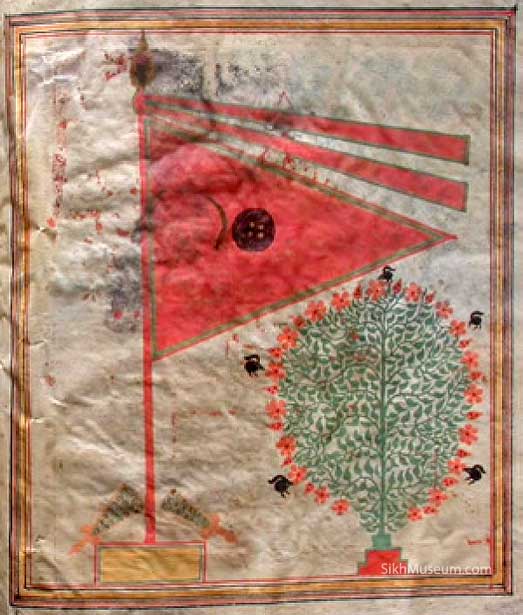

This flag was painted in a manuscript about 1775. It carries a curved sword and a round shield. The familiar Khanda is missing. Yet this, too, is a Sikh flag. It belonged to people for whom these shapes were enough.
The emblem takes its name from the straight sword at its centre. The sword is old. This arrangement of the weapons is much newer: it appears in photographs from Amritsar, in Punjab, around 1905 and 1906. Nobody knows who first drew it.
That does not make the sign less precious. But it does open a door. What did the sword mean before it entered the circle? And what do we do with a meaning we love when we learn there is more to it?
The sword and the circle
A khanda is a straight sword with two cutting edges. Its name belongs to a family of words about cutting and dividing. A khand can mean a part, a region, a realm. Japji Sahib, a Sikh morning prayer, describes five realms of spiritual life, from duty to truth. The word gives a name to each part of the journey.

Around the sword is a chakkar, a steel ring once thrown in battle. Its edge could wound. In the emblem, the same ring can lead the mind toward something that cannot be cut into parts.
Follow a circle with a finger. There is no place where it begins, no place where it must end. A common Sikh reading sees the eternal One in that unbroken line. We are born and we die. The circle keeps going.
Another reading sees time and space in the circle, with the central sword reaching beyond it. The ring holds the world we can measure. The blade points beyond its limits. The same few lines can suggest both the endless One and a world held within the One.
The two curved blades are commonly called kirpans. All three kinds of weapon carry memories of danger, skill and protection. Yet in the Gurus' poetry, a sword can also cut through ignorance: the things we have not understood about ourselves.
The sword of knowing
Guru Nanak, the founding Sikh Guru, or spiritual teacher, gave the sword another task. In the Guru Granth Sahib, the Sikh scripture, he pictures the soul as a woman taking up the sword of knowledge to face her own mind.
ਗਿਆਨ ਖੜਗੁ ਲੈ ਮਨ ਸਿਉ ਲੂਝੈ ਮਨਸਾ ਮਨਹਿ ਸਮਾਈ ਹੇ ॥੩॥
giān khaṛag lai man siu lūjhai manasā manah samāī he |3|
Taking the sword of knowledge, she wrestles with the mind, and desire is drawn back into the mind itself.
Guru Nanak, Raag Maru Solhe, ang 1022.
Here the sword is knowledge, and the struggle is with our own mind. We can want something so much that we stop asking whether it is right. We can be so proud that we refuse to admit a mistake. The sword of knowing cuts through the excuses that keep us from facing the truth.
Suppose we have made a mistake, but are busy finding reasons to blame someone else. Then we admit, even quietly, that the mistake was ours. It may hurt our pride. It also frees us to put things right.
The cut is through the excuse we wanted to keep. This is one way to understand the old image: knowledge making room for honesty.
In another verse, Guru Nanak uses the sword differently. Its narrow edge becomes the path a seeker walks.
ਖੰਡੇ ਧਾਰ ਗਲੀ ਅਤਿ ਭੀੜੀ ॥
khaṇḍe dhār galī at bhīṛī |
The lane is very narrow, a sword's edge.
Guru Nanak, Raag Maru, ang 1028.
In this second image, following the path is like walking along a blade. Each step needs care. There is little room for the pride that says we cannot be wrong. The sword can picture both the honesty we need and the difficulty of living by it.
This link between wisdom and a blade appears in other traditions too. In Buddhist art, Manjushri, the figure of wisdom, carries a sword that cuts through ignorance. The blade stands for understanding that clears away confusion.
But the Sikh sword also carries the memory of real danger. A person can learn to quiet anger and still need to stand beside someone who is being harmed. The inward struggle does not make the world outside disappear.
The two swords
In 1606, Guru Arjan, the fifth Sikh Guru, was martyred while held by the Mughal emperor. His son, Guru Hargobind, became the sixth Guru. He rode armed, kept horses and led a community learning to defend itself.
Bhai Gurdas, who knew the early community, preserves its questioning voices. The earlier Gurus, they say, sat and taught. This Guru moves from place to place. He hunts.
ਮੰਜੀ ਬਹਿ ਸੰਤੋਖਦਾ ਕੁਤੇ ਰਖਿ ਸਿਕਾਰੁ ਖਿਲਾਇਆ।
mañjī bah santokhadā kute rakh sikār khilāiā |
They sat on the cot and taught contentment; he keeps dogs and enjoys the hunt.
Bhai Gurdas, Var 26, pauri 24.
The questions carry a familiar worry: can a teacher of peace also carry a weapon? The followers had learned to recognise holiness in one way. Now their Guru stood before them in another.
Bhai Gurdas ends by affirming the Guru. A Persian account from the time also describes his armed life. Later accounts tell the familiar story of his two swords: miri, the power to lead and protect a community, and piri, the wisdom to guide its spiritual life.
The paired blades in the emblem keep that memory. Prayer and action belong in one life. Care that never acts can leave the weak alone. Strength without care can become cruelty. Each sword gives the other a reason to be there.
The word kirpan carries a teaching of its own. Many Sikhs hear kirpa, mercy, joined to aan, honour. Sanskrit has an older word, kripana, meaning a sword. The older word names the blade; the familiar Sikh explanation tells the hand how to hold it. Mercy and honour belong with strength.
Another Sikh phrase sets a cooking pot beside the sword: Deg Tegh Fateh. Victory to the pot and the blade. The pot feeds; the sword protects. The saying appears on Sikh seals and coins, and its meaning reaches into the life beneath the flag.
A pot without protection can be taken away. A sword without a pot can forget what it is for. Together they make the promise plain: there should be food for the hungry, and someone willing to stand beside the vulnerable.
The pot and sword express the same care and courage as the paired blades. The shapes are easy to draw. Keeping those qualities together takes a life.
You are the sword
With the tenth Guru, Guru Gobind Singh, the sword enters praise. The Dasam Granth, a collection associated with him, holds poems about weapons and divine power. One work, Bachittar Natak, tells of his life. It begins with a bow to the blade.
ਨਮਸਕਾਰ ਸ੍ਰੀ ਖੜਗ ਕੋ ਕਰੋਂ ਸੁ ਹਿਤੁ ਚਿਤੁ ਲਾਇ ॥ ਪੂਰਨ ਕਰੋਂ ਗਿਰੰਥ ਇਹੁ ਤੁਮ ਮੁਹਿ ਕਰਹੁ ਸਹਾਇ ॥੧॥
namasakār srī khaṛag ko karon su hit chit lāi | pūran karon giranth ihu tum muh karahu sahāi |1|
I bow to the revered Sword with love, with heart and mind set on it. Help me, that I may finish this granth.
Guru Gobind Singh, Bachittar Natak, Dasam Granth.
The granth he hopes to finish is his book. As the praise unfolds, he calls the sword protector and source of the world. The poem's heading names Kal, Time. The steel blade now points toward the power that gives life and takes it away.
In Chandi di Var, another poem in that collection, the khanda appears before the world.
ਖੰਡਾ ਪ੍ਰਿਥਮੈ ਸਾਜ ਕੈ ਜਿਨ ਸਭ ਸੈਸਾਰੁ ਉਪਾਇਆ ॥
khaṇḍā prithamai sāj kai jin sabh saisār upāiā |
He first fashioned the khanda, and then brought forth the whole world.
Guru Gobind Singh, Chandi di Var, pauri 2, Dasam Granth.
The word khanda can carry this meaning of creation too. In his Mahan Kosh, the great Punjabi dictionary, Bhai Kahn Singh Nabha gives it another sense alongside the weapon: maya, the power that makes a world of separate things. The blade can stand for the making of many forms, each with its own shape and name.
Seen this way, the blade and the circle hold two thoughts together. The blade divides. The circle remains whole. Countless forms, one life.
The poems also speak directly to divine power. In Shastar Nam Mala, another poem in the Dasam Granth, the voice addresses a beloved You.
ਕਾਲ ਤੁਹੀ ਕਾਲੀ ਤੁਹੀ ਤੁਹੀ ਤੇਗ ਅਰੁ ਤੀਰ ॥ ਤੁਹੀ ਨਿਸਾਨੀ ਜੀਤ ਕੀ ਆਜੁ ਤੁਹੀ ਜਗਬੀਰ ॥੫॥
kāl tuhī kālī tuhī tuhī teg ar tīr | tuhī nisānī jīt kī āj tuhī jagabīr |5|
You are Time, You are Kali, You are the sword and the arrow. You are the sign of victory; today You are the hero of the world.
Guru Gobind Singh, Shastar Nam Mala, Dasam Granth.
Kali is a goddess revered in Hindu traditions. Ram and Krishna, named later in the poem, are revered divine figures too. Time, goddess, sword, arrow: the names keep changing; the address remains You. A reader who hears the One through them all finds a power that no single name can hold.
Some readers hear the weapons most strongly. Others hear the goddess, or the strength of the Creator. The poem has carried these different readings, each drawing the eye toward another part of its wonder.
A person we love is more than their name. Yet hearing that name can bring them close. Something like this can happen with a sacred image. The sword is loved, and the love reaches beyond the steel.
Such praise still leaves a hard question: when is it right to use a weapon? In the Zafarnama, his letter to the emperor Aurangzeb, Guru Gobind Singh places the sword after other means have failed. Last, not first.
The bowl
There is another place to meet the sword: in a bowl of water.

At Anandpur, in Punjab, in 1699, Guru Gobind Singh founded the Khalsa. Those who join this Sikh community through initiation take on a shared discipline and duty to serve. The ceremony is called khande di pahul, initiation with the double-edged sword. Today, water and sugar are placed in an iron bowl. Prayers are recited while a khanda stirs the water.
Those who receive amrit, the water of initiation, enter a shared way of life. The blade is there, but so is sweetness. In Sikh teaching, that meeting can recall the strength and tenderness a person needs to carry together.
Kavi Sainapati, a poet associated with the Guru's court, names the rite in Sri Gur Sobha, an early account of the Guru's life.
ਖਾਂਡੇ ਕੀ ਪਾਹੁਲ ਦਈ, ਕਰਨਹਾਰ ਪ੍ਰਭੁ ਸੋਇ ।
khāṇḍe kī pāhul daī, karanahār prabh soi |
He gave the pahul of the khanda, that all-doing Lord.
Kavi Sainapati, Sri Gur Sobha, chapter 5.
His telling is brief. Later accounts describe the Guru asking who would offer their life, and five volunteers stepping forward. They become the first to receive the initiation. The fuller story and the early verse reach us from different times. The ceremony carries that memory into another generation.
A blade divides. That is what blades are made for. Yet here it moves through water, and the people who drink become part of one family. The sword keeps its edge, but the work it does in the bowl is to join.
Someone looking at the central blade may remember their own initiation. Someone else may remember a parent preparing for that day. A child may simply wonder why a sword is stirring water. Each has met something real in the same shape.
Long before the emblem was drawn, the sword already had these meanings. In prayer it could cut through pride. In a hand it could protect. In poetry it could name divine power. In the bowl it could join people into one family.
The old flags
The sword had also appeared on flags for generations before the modern emblem took shape. The older flags carried many designs: a blade, a shield, a dagger, a field of colour. They did not all look alike.
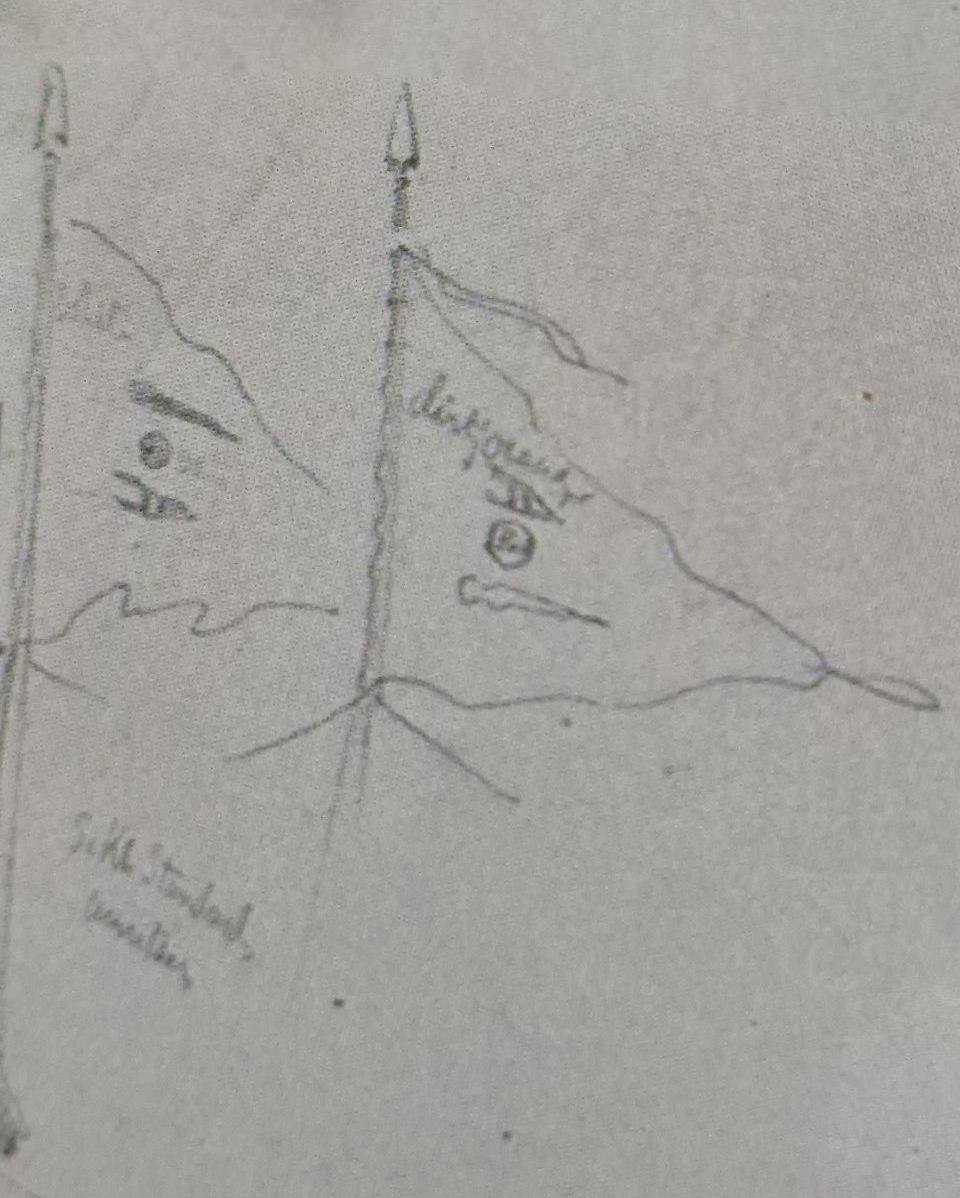

William Simpson's drawing from 1860 shows weapons gathered on a Sikh standard. Look slowly. A shape we know well can make us overlook the differences in an older picture.
Other pieces were worn. The Nihangs, the Sikh warrior order known for blue dress, carried steel rings in their tall turbans. Nineteenth-century images show blades and crescents there too. Military badges brought a straight sword and a ring together. The shapes were close to hand long before they settled into one design.
In the Amritsar photographs of 1905 and 1906, a young Nihang wears the joined emblem in his turban. By 1911 it appears on a flyer in Vancouver, Canada, announcing a celebration of Guru Gobind Singh's birth.
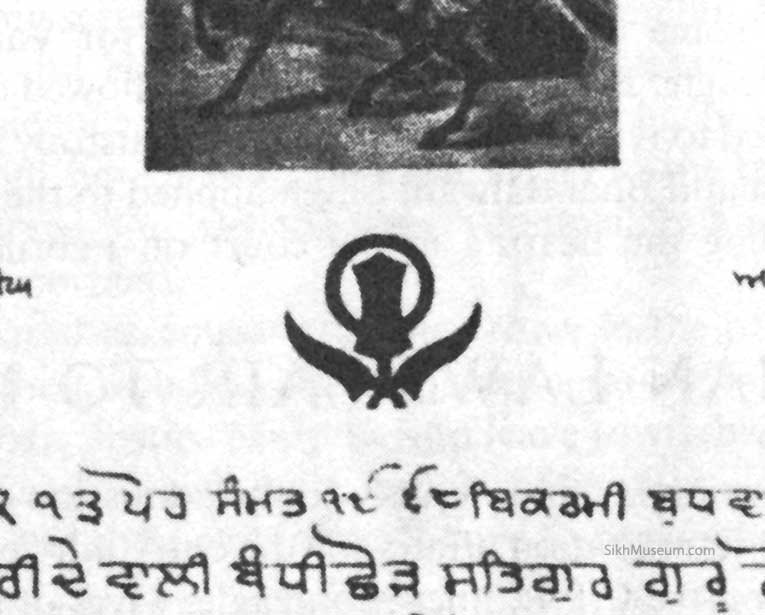

The flyer was made to bring people to a gathering. Far from Punjab, the sign had found a place beside an invitation. Its outer swords sit at a different angle from many Khandas drawn today, but the family likeness is clear.
Who first joined the shapes? Who carried the design from one place to another? The surviving pictures do not tell us. They show a sign being used, copied and made familiar. Older designs continued beside it.
The Sikh Rehat Maryada, the code of conduct, gives colours for the flag and allows a spearhead or khanda at the top of its pole. It does not require the modern emblem on the cloth. The familiar design became shared through the people who used it.
Its meanings passed from person to person too. We can trace some of the pictures more easily than the words spoken beside them. A lesson might pass from parent to child for years before anyone wrote it down.
The drawings changed. The need to recognise one another remained.
Room for another meaning
A short answer is a gift. It helps a child remember. It gives a teacher somewhere to begin. The One, the endless circle, the two swords: there is much to live by in those few words.
The trouble begins when one answer is made the only answer allowed. A child finds an old flag and asks why it looks different. The question could lead to a story. It could also be met with anger. What the child learns next depends on the reply.
This can happen in a family, a committee, an institution, or quietly inside one mind. A meaning becomes a rule for who belongs. A question becomes a threat. The sign has not grown smaller, but the room around it has.
A new discovery can become another rigid answer. Someone who learns that the drawing is newer than expected may dismiss those who love it. But an old photograph can only show that a sign was already in use. It cannot tell us all that someone has found in it.
We inherit something rich. We keep a useful part. Then we can forget it was a part.
In the third pauri, or stanza, of Japji Sahib, Guru Nanak gives room to many singers.
ਗਾਵੈ ਕੋ ਤਾਣੁ ਹੋਵੈ ਕਿਸੈ ਤਾਣੁ ॥
gāvai ko tāṇ hovai kisai tāṇ |
One sings of the One's power, whoever has the strength to sing of it.
ਗਾਵੈ ਕੋ ਦਾਤਿ ਜਾਣੈ ਨੀਸਾਣੁ ॥
gāvai ko dāt jāṇai nīsāṇ |
Another sings of the gifts, and knows them as a sign of the Giver.
ਗਾਵੈ ਕੋ ਗੁਣ ਵਡਿਆਈਆ ਚਾਰ ॥
gāvai ko guṇ vaḍiāīā chār |
Another sings of the beautiful qualities, of greatness.
ਗਾਵੈ ਕੋ ਵਿਦਿਆ ਵਿਖਮੁ ਵੀਚਾਰੁ ॥
gāvai ko vidiā vikham vīchār |
Another sings through learning, through hard and careful thought.
Guru Nanak, Japji Sahib, pauri 3.
The singers come by different paths, and none can finish telling of the One. The Giver keeps giving, while the voices rise and fall.
The word for sign in the second verse is nisan, also heard in Nishan Sahib, the name of the flag. The gifts of life are signs of the Giver. The flag can do something like that: help a person remember the One, without holding all that the One is.
Imagine four people looking up at it. A Nihang might see the weapons his order has carried for generations. A teacher might see the One and the two swords of Guru Hargobind. A historian might remember the old photographs. A child might ask why a place of prayer has a sword above it. Each sees from where they stand. The question lets the conversation grow.
At the opening of Japji Sahib, Guru Nanak names what endures through all these changing views.
ਆਦਿ ਸਚੁ ਜੁਗਾਦਿ ਸਚੁ ॥
ād sach jugād sach |
True at the beginning of time, true through all the ages;
ਹੈ ਭੀ ਸਚੁ ਨਾਨਕ ਹੋਸੀ ਭੀ ਸਚੁ ॥੧॥
hai bhī sach nānak hosī bhī sach |1|
true here and now, and, says Nanak, true for ever after.
Guru Nanak, Japji Sahib.
Sat means the true, the real, the enduring. The drawing can change. The words used to explain it can change. The One remains larger than every drawing and every explanation.
A window shows a real piece of sky. It misleads only when we insist the sky ends at the frame. A meaning can be precious and still leave room for what we have not seen.
Perhaps the sword recalls a moment when you stood beside someone who was afraid. Perhaps it reminds you of the relief of admitting a mistake. Perhaps the circle brings back the person who first taught you to pray. The same sign can meet a person differently at different times in a life.
Above the gurdwara, the wind opens the cloth. A sword, a circle, two curved blades. Beneath it, another place is made for someone to sit and eat.
For a moment, the thought of who has the right answer can fall quiet. There is the cloth moving, the person beside us, the warmth of a meal.
Sources
Scripture and early voices. Guru Granth Sahib, angs 1, 2, 1022 and 1028, from the BaniDB text; Japji Sahib, pauri 3. Dasam Granth: Bachittar Natak, Chandi di Var pauri 2, Shastar Nam Mala (opening verses, including verse 5), and the Zafarnama. Readings of the sword and divine power differ; Robin Rinehart's Debating the Dasam Granth discusses that interpretive history. Bhai Gurdas, Var 26 pauri 24, preserves questioning voices about Guru Hargobind and closes by affirming him. Kavi Sainapati, Sri Gur Sobha, chapter 5, names khande di pahul; it does not narrate every detail familiar from later accounts of 1699. Karamjit Malhotra and J. S. Grewal discuss those accounts. The Dabistan-i-Mazahib, about 1645, describes Guru Hargobind's armed life; see Irfan Habib's translation in J. S. Grewal and Irfan Habib, Sikh History from Persian Sources (2001). The later two-sword narrative and its terminology should not be read back into every early witness. Objects and their dates. Sandeep Singh Brar's Nishan Sahib exhibition at SikhMuseum.com gathers the flags, paintings, military badges and photographs. Its early modern-emblem examples include the Prince of Wales visit photograph, dated about 11 December 1905, Hannah P. Adams's photograph, dated about 24 January 1906, and the Khalsa Diwan Society's Vancouver flyer of December 1911. These establish appearances of the design, not its invention date or its designer's intention. The manuscript flag is catalogued at about 1775; Simpson's drawing is dated 1860. Each image has its own provenance and rights link. See also W. H. McLeod, Popular Sikh Art (1991) and Sikhism (1997), and the Encyclopaedia of Sikhism, entry Sikh Insignia. Living practice. The SGPC's Sikh Rehat Maryada, chapter IV, article V(r), gives the flag rule, including the spearhead or khanda finial; the initiation section describes the present ceremony. Its langar provisions welcome people without distinctions of religion or caste. Still open. Who first drew the joined emblem? How did it move between military badges, turban ornaments and flags? When were its familiar symbolic explanations first taught? The photographs and flyer cannot answer these questions by themselves. The imagined child and teaching exchanges in this essay are reflections, not reported incidents. Words and symbolic readings. Bhai Kahn Singh Nabha, Mahan Kosh, entries khanda and khand, via SriGranth: khanda includes the weapon and a sense of maya as that which produces a world of divisions; it does not literally say that the One is cut into pieces. Monier-Williams gives Sanskrit kripana as a sword. The Sikh Advisory Board records the devotional explanation kirpa (mercy) and aan (honour). These are distinguished here as word history and a living teaching. Sikhs.org presents the sword as divine knowledge and the circle as eternal; the Encyclopaedia of Sikhism, entries Sikh Insignia and Deg Tegh Fateh, records other readings of the sword and circle, and the pot and protecting blade. These are interpretations, not a recovered statement from the emblem's unknown designer. Guru Nanak Nishkam Sewak Jatha discusses strength and compassion in the initiation ceremony. The Metropolitan Museum's Manjushri entry describes his sword of wisdom. The image of division held within wholeness, and the window and sky, are reflections offered here, not scripture translations. The English Japji excerpts follow this site's reading, with punctuation adapted to the essay.
- SikhMuseum: the modern Khanda
- SikhMuseum: flags of the Sikh kingdom
- SikhMuseum: Nihang flags
- SikhMuseum: blades and crescents in Nihang turbans
- Metropolitan Museum: Sikh quoit and its use
- SikhMuseum: military emblems
- Guru Granth Sahib, ang 1022
- Bhai Gurdas, Var 26
- Sri Gur Sobha, chapter 5
- Sikh Rehat Maryada (SGPC)
- Mahan Kosh: khanda
- Encyclopaedia of Sikhism: Sikh Insignia
- Encyclopaedia of Sikhism: Deg Tegh Fateh
- Sikhs.org: meanings of the Khanda
- Sikh Advisory Board: kirpa and aan
- Monier-Williams: kripana
- Shastar Nam Mala: You are Time, You are Kali
- Nishkam: strength and compassion
- Metropolitan Museum: Manjushri and the sword of wisdom
- Japji Sahib: the opening and many singers
- BaniDB: Shastar Nam Mala source text